TimeMachine OS
TIME
Simulate earthquakes, buildings, markets, and science before decisions, then score predictions against what actually happens.
Start with measurable domains. Every prediction must keep inputs, uncertainty, and observed results.
Core stance
The time machine begins as a discipline of simulation.
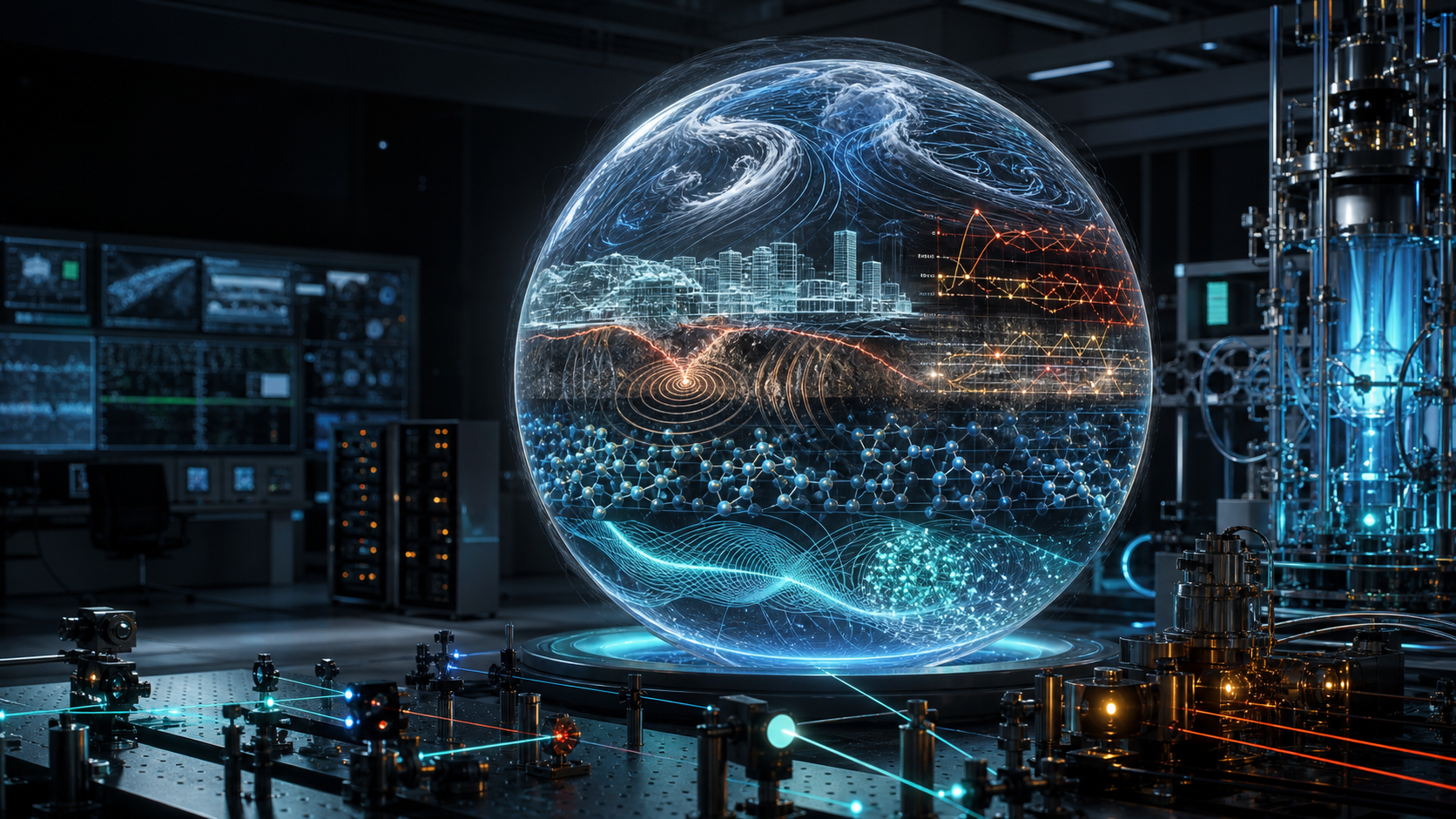
TIME is built for projects where predictions can be checked: earthquake waves, building plans, CPI and society events, prediction markets, statistical outcomes, financial paths, materials, weather-like systems, and eventually quantum-assisted scientific models.
What TIME does today
Scenario packets, model registry, scoring loop.
Operating loop
One OS for building, testing, and correcting models.
TIME is not a prophecy page. It is a place where models must leave evidence, numbers, uncertainty, and feedback.
Ingest
Collect numerical signals, public data, private project data, sensor feeds, expert assumptions, and model parameters into one audit trail.
Simulate
Run scenarios across physical systems, buildings, markets, society events, and future quantum-informed scientific models.
Score
Compare forecasts against realized numbers with backtests, error bands, calibration records, and model-versus-model tournaments.
Operate
Turn useful models into dashboards, alerts, decision records, digital twins, and repeatable experiments for the next run.
Model fields
TIME starts where feedback is visible.
Numbers are easier to check than stories, so the first OS surfaces favor measurable outputs with clear status labels.
Earthquake simulation
Ground motion, structure risk, fault scenarios, aftershock paths, and uncertainty maps become a shared simulation layer.
Building plan modeling
Plans, land constraints, cost assumptions, regulation checks, and valuation logic become testable digital twins.
Society event markets
Prediction markets, event ledgers, macro indicators, and narrative claims are scored against public outcomes.
Statistical outcomes
Portfolio paths, market regimes, risk scores, and trading hypotheses can be checked daily instead of debated forever.
Natural science twins
Weather-like fields, materials, atom-scale assumptions, and lab-derived measurements prepare the bridge to deeper physical simulation.
Public status: Namazu, AutoCalc, CPI/events, finance, and matter are presented here as model lanes for the OS. Live claims should be published only as scored scenario packets.
Preview console
A small public face for a larger simulation OS.
Sample registry
Every model needs a packet, a score rule, and an observed result.
| Model ID | Domain | Status | Horizon | Score Rule | Last Observed |
|---|---|---|---|---|---|
| nmz-wave-v0 | Earthquake | Seed | 72h | Error band vs observed motion | Demo placeholder |
| ac-building-v0 | Building plan | Seed | 18m | Plan/cost delta after update | Demo placeholder |
| cpi-event-v0 | Society event | Seed | 30d | Brier/log score | Demo placeholder |
Quantum path
Led by quantum optics experience, grounded in model evidence.
The initial TIME direction is led by a developer with Kyoto University quantum physics background, including quantum optics work around Yb laser cooling and Bose-Einstein condensation experiments.
That background matters because TIME is not only a data dashboard. The mid-term path is to move from public numerical signals into reproducible scientific model packets: fields, materials, atom-scale assumptions, uncertainty calibration, lab-data validation, and spherical natural systems that cannot be reduced to simple scraped data.
This public page makes no claim of physical time travel. It frames the simulation OS layer that can support forecasting, causality, digital twins, and future time-dependent physical-system research.
- Now
- Classical simulation, backtests, event scoring, and digital twins
- Next
- Physics-aware model registries and reproducible scenario packets
- Mid term
- Quantum-informed simulation experiments for natural science fields
- Long term
- Digital twin layer for time-dependent physical-system research